Setting up a hamster or gerbil home: space, bedding and burrowing

Hamsters and gerbils are often grouped together as first pets, yet they live in quite different ways. A hamster is a solitary night-time forager that fills its cheek pouches and hoards food; a gerbil is a sociable digger, busy at dawn and dusk, that builds tunnel systems with its companions. Get the home right and both are fascinating to watch. This guide covers the practical set-up. For anything to do with health, a change of diet or behaviour that worries you, speak to a vet who sees small animals.
Know who you are housing
- Syrian hamsters must live alone once they are adult, because they will fight if kept together.
- Dwarf hamsters, such as Roborovski, Campbell’s and winter white, are smaller and very quick. Some live in pairs, but fallings-out are common, so be ready to provide a second home.
- Gerbils should not be kept on their own. A pair or small group of the same sex, introduced while young, is the usual arrangement.
Space: judge by floor area
Both species are far more active than their size suggests. Choose the largest enclosure you can fit, and judge it by its floor area rather than by its number of levels: ramps and platforms add interest but do not replace room to run. UK welfare charities publish recommended minimum sizes, and those recommendations have grown as understanding has improved, so look up the current guidance from organisations such as the RSPCA or Blue Cross before you buy. As a rough test, if an enclosure would fit comfortably on a bookshelf, it is probably too small.
Tank, cage or wooden enclosure?
- Glass tanks with a mesh lid hold deep bedding without scattering it and suit gerbils especially well, as they dig constantly. Make sure the lid gives plenty of airflow.
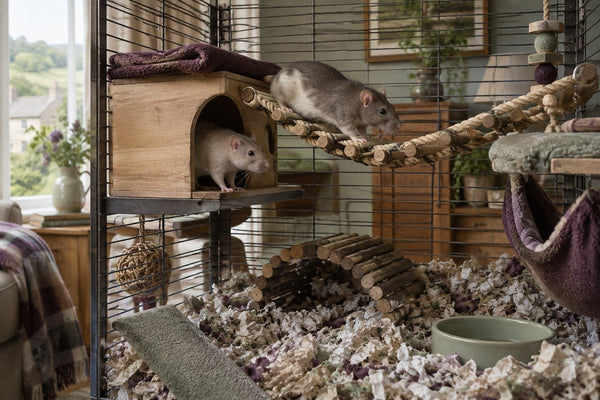
- Wire-topped cages with a deep plastic base are well ventilated. Check that the bars are close enough together to prevent escapes, because dwarf hamsters squeeze through surprisingly narrow gaps, and that the base is deep enough for proper bedding.
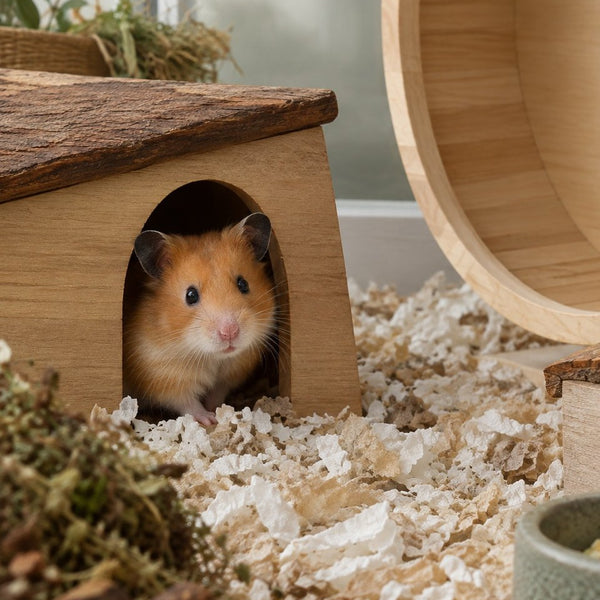
- Wooden enclosures look handsome and are popular for hamsters. Choose one with a sealed or lined floor so that it can be wiped clean.
Bedding deep enough to dig
Burrowing is not an optional extra: it sits at the heart of how both animals live. Use a paper-based or similar small-animal bedding at a depth that holds the shape of a tunnel. For hamsters that often means 15 to 20 centimetres or more, and gerbils appreciate deeper still in at least one part of the enclosure. Mixing in a little hay helps tunnels keep their shape. Choose unscented bedding, avoid aromatic wood shavings such as cedar, and skip fluffy cotton-wool style nesting, which can wrap around tiny legs; plain paper strips make a safer nest.
The wheel
A wheel gives a hamster somewhere to cover the distance it would roam overnight in the wild. It should have a solid running surface, with no rungs or mesh, and be large enough for your hamster to run with a level back rather than one arched upwards. For an adult Syrian that usually means a diameter of at least 28 centimetres; dwarf hamsters can use a slightly smaller wheel. Gerbils enjoy a solid wheel too, although many prefer digging and a sand bath.
Hides, tunnels and things to gnaw
Offer several hiding places in different spots, including at least one sitting on the floor and buried in bedding. Cardboard tubes, wooden bridges, cork logs and plain wooden chews keep teeth and minds busy. Gerbils particularly appreciate multi-chamber hides and a shallow dish of chinchilla sand for bathing. Leave out soft plastic items that are easy to chew and swallow.
Food and water
A heavy ceramic dish is hard to tip over and easy to wash. Many hamsters and gerbils drink happily from a water bottle, while others prefer a shallow, heavy water bowl; offering both for a while shows you which your pet uses. Check the bottle spout every day, and follow the feeding guidance on a good-quality food made for the species.
Where to put it
- A quiet room with a steady temperature, away from radiators, direct sun and draughts.
- Probably not a bedroom if anyone sleeps lightly: hamsters are busiest at night, and wheels and gnawing can be noisy.
- Well out of reach of cats and dogs, whose presence alone can unsettle small animals.
- On a sturdy surface, at a comfortable viewing height.
Cleaning without undoing their work
Spot-clean soiled corners every day or two and refresh the water daily. During a fuller clean, replace only part of the bedding and leave some of the old, familiar-smelling material behind. Hamsters and gerbils put real effort into their tunnels and food stores, and a complete clear-out can be unsettling for them.
Set-up checklist
- A large enclosure, judged by floor area
- Deep, unscented, paper-based bedding
- A solid wheel of the right size
- Several hides, tunnels and chews
- A heavy food dish, plus a water bottle or bowl
- A sand bath for gerbils
- A quiet, draught-free spot
Browse small animal supplies or habitats and housing. Every UK delivery is free, and anything unused can come back to us free of charge within 30 days. Have a question about a particular enclosure or wheel? Get in touch.